Introduction
How did Waardewenders start?
“It started with Herrejan, the founder, who was already deeply involved with paper because he owned a printing company. Over time, he saw the graphic sector changing: due to digital developments, the demand for paper dropped, but at the same time, paper will never completely disappear.
Paper is a natural product, made up of fibres. Even though not all fibres are easy to replace with more sustainable alternatives, we still felt paper had to be part of the sustainability movement. Raw materials are running out and the waste pile only keeps growing, so we have to look for other sources.
In response to that need, Waardewenders stepped up and began pioneering. Through trial-and-error and in collaboration with a paper mill, we investigated what was possible. That’s how he came across verge grass: a residual stream full of natural fibres. From there, the next question arose: how do you take the next step towards ecological management? Where can you make things more sustainable to make an impact and set yourself apart? From this, an actual product emerged that also fits within the circular chain: paper made with verge grass.”
What led to the choice of verge grass as a raw material?
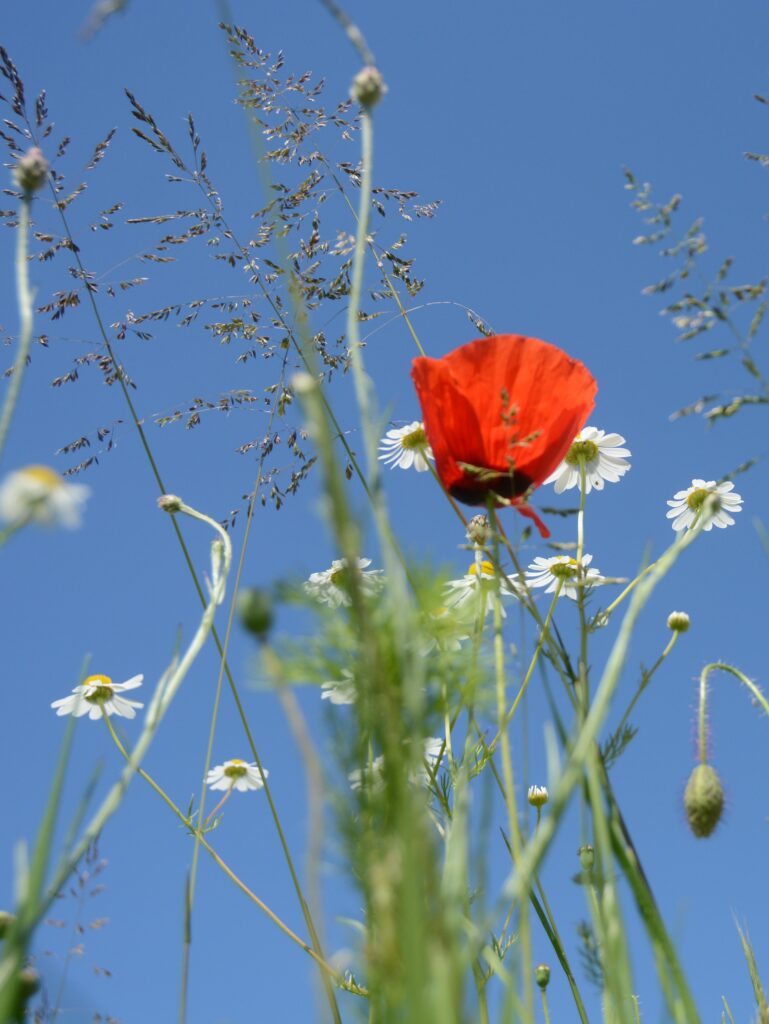
“The landscape is quite fragmented, including the nature reserves. The strips of verge grass along the road form corridors between these areas. For example, take the wild bees: they aren’t doing well. They can fly about 3 kilometres (almost 2 miles), but that isn’t always enough to reach the next nature reserve. But if you sow flowers on those corridors along the road, the bees can forage along the way and reach the next nature reserve.
These areas are already managed and mowed for road safety. On top of that, it’s a residual stream that can be put to use instead of being thrown away or composted. Not the verge grass along the motorway though, that’s full of rubbish and too dirty to use. It’s the verges along cycle paths and nature reserves, those are ecologically managed and actually clean.
We want to put this fibre to use, since it can’t go into the food industry and it actively supports biodiversity. This can motivate municipalities to rethink how they manage their verges. Instead of mowing them down, they can serve a real purpose.”
Waardewenders’ Grass Paper
What is Waardewenders’ grass paper made of?
“Our paper is paper with verge grass, because verge grass on its own would require chemical binders. That’s why we mix it with recycled paper that already exists. To give it sturdiness, we add a small amount of new cellulose and some fillers like chalk and potato starch. That’s why we don’t need chemical binders. About 10% is verge grass, most of it is recycled paper, and the rest is a small amount of fillers.”
How does your paper differ from conventional paper?
“The paper doesn’t differ much from conventional paper, because it runs through a printer just fine, is fully recyclable, and works for normal everyday use. That said, it remains a natural product, so a fibre can sometimes come loose. Very thick paper can occasionally crack if you don’t crease it properly. Commercial printers sometimes run into this, but home users with a regular printer won’t notice it.
The paper is also slightly bulkier: there’s a bit more air between the fibres, which makes it a touch thicker than standard paper. If, for example, you want to print a 200-page book and ship it, keep in mind that the book will be slightly thicker. For single-sheet print work, you won’t feel the difference.
Furthermore, there is a slight colour difference in the paper, again because it’s a natural product. Paper from a dry year comes out lighter, paper from a wetter year slightly darker. That’s why we don’t offer a colour guarantee: we depend on the fibres themselves. Between print runs, a slight shade difference may be visible. In addition, the paper also isn’t white, which can have an effect on how colours print. However, we have been told that people find the paper pleasant to write on, because the surface is a bit rougher.
It is very accessible paper, the only barrier is sometimes the price. But you know exactly where it comes from, and you’re directly contributing to a greener environment.”
How do you measure or prove the impact of your paper?
“We’ve had the environmental impact of our paper investigated through a Life Cycle Analysis (LCA). The study examined the CO2 impact of the entire process, the origin of all raw materials, and the paper mill itself has been looked into. Everything was included within the analysis, and anyone can request access to it. In addition, we are also affiliated with NL Green Label.”
How do clients and end users react to a visibly ‘different’ material like your paper?
“Those really are two extremes. Some people think it’s fantastic, beautiful, gorgeous, while others go: “looks like cheap newsprint” Opinions range from “stunning” to “throw it back where it came from”.”
Working with Designers
What do you wish designers understood better about sustainable materials?
“What is the whole story? What do you want to convey? What are your choices based on? Is that solely your own message as a designer? And how do you make that visible? Do you let it come through in your choice of materials? It depends on what the designer wants to show, what choices they want to make, and to what extent they want to contribute. In addition, the client is a major factor; their voice and preference weighs heavily in the choices made.
Beyond the practical side, what I’d really love is for designers to understand the story. That they’ve thought about where a product or material comes from. That the story starts to come alive, and that we all look at the bigger picture. Every drop may seem small on its own, but together they still make a shower.
If designers know more of the whole story, from origin to end product, you can tap into their intrinsic motivation more directly: the awareness of what you’re doing and what you stand for.”
How do you currently collaborate with designers?
“First of all, we very much want to share the whole story with people, including designers. We believe that if you know the story, it informs your choices. And if you still choose something else, that’s fine, but then at least it’s a conscious choice.
We do advise designers about our paper and what it can do. We can emboss, die-cut, and much more. If something isn’t possible, we’re honest about that and we think along to find a creative solution.
Working with designers isn’t our ‘core business’’. But when designers visit us, we’re happy to think along about ideas. And if they have ideas and want to try something out, we’re curious about that too. Do let us know, because we learn from those exchanges as well.”
In your view, what’s needed to make bio-based materials more mainstream in the creative sector?
“What’s special about the creative sector is that they’re already very open to this. Especially the new generation of designers is much more consciously engaged with these things. They’re passionate, they stand by what they do, they make conscious choices, and they want to make a difference. That gives me a lot of hope.
Something else I notice is that the new generation asks many more questions. They dare to dig deeper and don’t stop at the final product. That keeps you sharp and motivates you to keep pioneering. I can only encourage that kind of collaboration.”
If you could give one piece of advice to young designers who want to work with more sustainable materials, what would it be?
“Know why you make your choice and what you base it on. If you can substantiate your choice and stand by it, then everyone has to respect that.”
Future
Where do you hope grass paper will be in ten years?
“Our mission is “geen wit papier, maar dit papier” (not white paper, but this paper). That is too big a goal for ten years. What I do hope is that awareness will have grown further and become the norm: thinking about the origin of your product or paper.
I also hope the negative image of paper shifts to something positive. It is often said: ‘digital is much more sustainable’, but that isn’t necessarily true. Emails are stored in data centres that use enormous amounts of energy. As long as paper stays intact and the fibres remain whole, the CO2 stays stored inside. It doesn’t keep using electricity, and in that sense it’s more sustainable than all those emails sitting in your inbox. That’s also why I find this booklet so interesting: it helps bring that idea back to people’s attention. So in ten years, I hope that image has improved and that this way of thinking has become more widespread.”
If your paper could speak, what would it say?
“The paper is proud of what’s in it. Proud of its contribution to biodiversity and caring for the wild bees. Proud that it reduces verge grass waste and stores CO2. Proud that it contributes to cleaner air and a greener environment. Proud that it uses local materials. Proud of the awareness it brings. And proud of that whole story, woven into a few fibres.”